






Comfortable Chicks Give Great Results
Keeping chicks well looked after and comfortable starts from hatch. What happens between hatch and the end of the first week will shape performance, health, and uniformity for the entire flock. Ensuring optimal conditions during holding, transport, and placement is key. Strong communication across the hatchery, transport provider, and farm team helps ensure the chicks have the best chance of success.
The Hidden Advantage: Residual Yolk
Newly hatched chicks carry a natural reserve of nutrients and water in the yolk sac. This can support the chick for up to three days after hatch. Because of this, chicks can be transported around the globe and tolerate short delays before placement. Tightening up the hatch window will improve the uniformity of the time before feeding and drinking, and ultimately the uniformity at placement. Extended periods without feed can increase the risk of dehydration and reduce early growth potential. The sooner chicks are placed and given access to feed and water, the better. Feed intake stimulates gut development and accelerates yolk sac absorption, supporting better early growth, crucial to good broiler growth.
Various systems aim to provide feed and water to chicks at, or very close to, hatch. These include hatching in the chicken house or in specialist hatchers with feed and water available in the trays. For broilers, there are pros and cons to each system, and depending on the specific circumstances and regulatory pressures, these may be a good solution. For breeders, early feeding systems and on-farm hatching are generally not feasible because chicks must be sexed and usually transported. Birds that have been fed before transport have higher metabolic heat production due to the activation of the digestive system. This leads to increased gut activity and moisture excretion, resulting in wet droppings that weaken the integrity of transport boxes, and during extended transport, may increase the risk of intestinal damage or even losses. In some parts of the world, transportation laws for animals that have been fed are much more restrictive than for those that have not.
At all times, the chicks must be maintained in the most biosecure state possible. Avoid mixing flocks from different hatchery sources in the same transport and utilize environmentally controlled vehicles where possible.
How is the temperature?
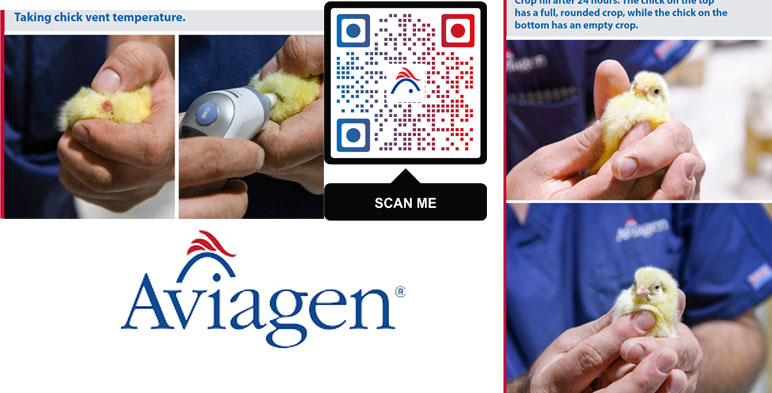
Newly hatched chicks cannot fully control their body temperature, which is influenced by the surrounding air. Chicks do produce some metabolic heat, so they will change their behavior to influence the microclimate around them. If they are cold, they will huddle to share body heat. If they are hot, they will maximize the distance between each other and pant. The body temperature of the chicks should be between 39.4 and 40.6 °C (103 and 105 °F). This can be easily measured using a Braun Thermoscan® thermometer on the vent. Monitoring chick temperature during holding, transport (if practical), and at delivery will provide feedback on the environmental temperature required to maintain their body temperature within the desired range, and the uniformity of temperature within the holding room or transport.
Poor temperature control can result in overheating and dehydration, or chilling, both of which can compromise chick quality. Typically, chilling has a greater impact on losses in the first 7 days than overheating; however, during transport, with chicks generating metabolic heat in boxes, this is less likely to occur. It is easy to overheat chicks when aiming to avoid chilling them.
The First Days: Where Performance Is Built
Once chicks arrive at the farm, the aim is to achieve strong early development and good uniformity. The house must be preheated to ensure that the floor and air temperatures are suitable for chicks before they arrive. Cool or wet floors will chill chicks when they are placed on them. Chicks should be able to find feed and water upon placement. Use chick paper, along with supplemental feeders and drinkers, to make this easier. Provide fresh, good-quality, crumbled feed on a “little and often” basis to encourage the chicks to eat. Ensure the water is cool, clean, and fresh to optimize drinking behavior. To better help the chicks find feed and water, run a high-intensity, long day (23 hours of light) for at least two days. Additional darkness can then be gradually added and light intensity reduced. Monitor the placement's success by observing chick behavior. The chicks should be evenly spread across the brooding area, with about a third sleeping, about a third eating, and a third drinking. Monitor crop fill to determine the percentage of birds that are eating and drinking. This should be done at least 2 hours and at 24 hours post-placement, with a target of 95% crop fill at 24 hours.
The chicks’ comfort from hatch to post-placement sets the stage for the rest of the flock's performance, regardless of whether they are broilers or breeders. Understanding whether the chicks are content throughout the supply chain requires communication and monitoring, especially of their behavior. Assess losses, uniformity, chick weight, chick temperature, crop fill, and 7-day weights to determine success.